
The two-year practical requirement for qualifying as a solicitor through the SQE — what counts, how it’s assessed, and when to start.
Qualifying Work Experience (QWE) is a fundamental requirement for most candidates qualifying through the SQE. This requirement is designed to ensure that you have the opportunity to develop the competences needed to practise as a solicitor in a professional environment.
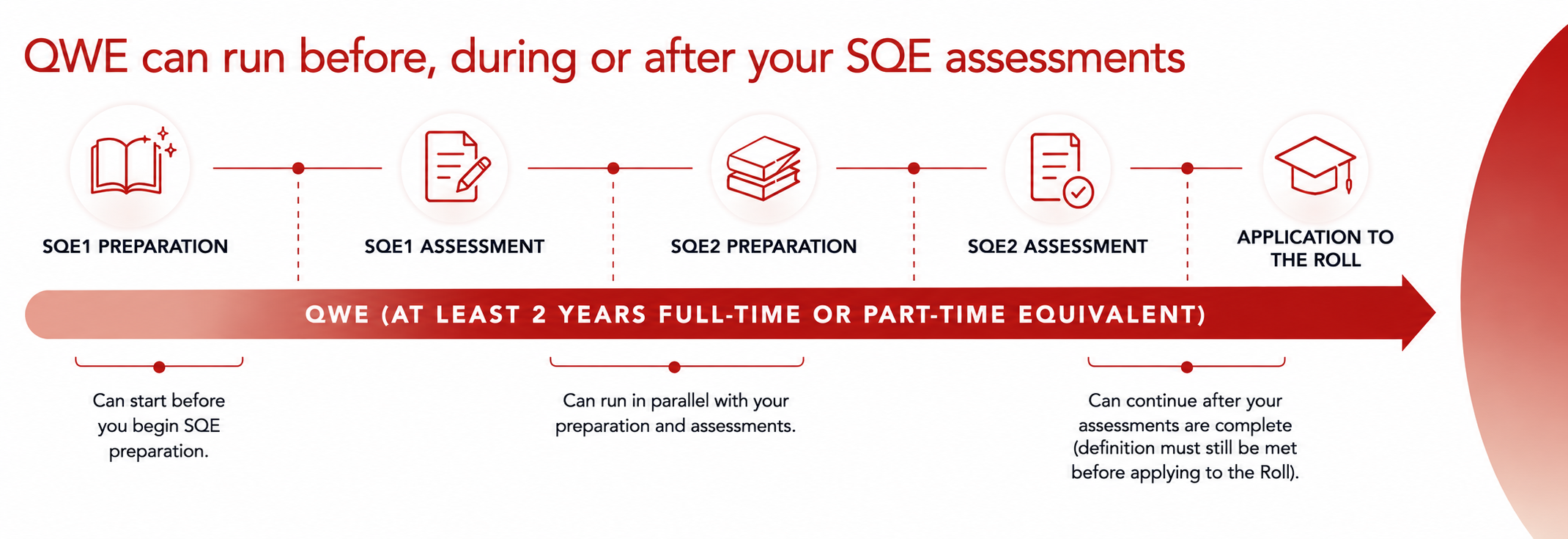
You must complete a minimum of two years of full-time QWE, or the part-time equivalent, before applying to become a solicitor in England and Wales. You can do your QWE before, during, or after your SQE assessments, but it must be completed before you apply for admission.
Foreign-qualified lawyers are automatically exempt from the QWE requirement. The SRA recognises existing qualifications and professional experience instead. For the full route, see our page for foreign- qualified lawyers.
Your QWE can be completed in the UK or abroad, and it does not need to involve English and Welsh law. You can draw QWE from up to four different employers, or complete it in one continuous block.
The aim is to give you real-life experience of providing legal services in an environment where you can develop the competences set out in the SRA’s Statement of Solicitor Competence. QWE can be paid or unpaid work and can include:
Your work can be in person or remote, contentious or non-contentious, or a combination of both. There is no requirement to cover a specified number of practice areas, and you do not need a mix of transactional and litigation experience.

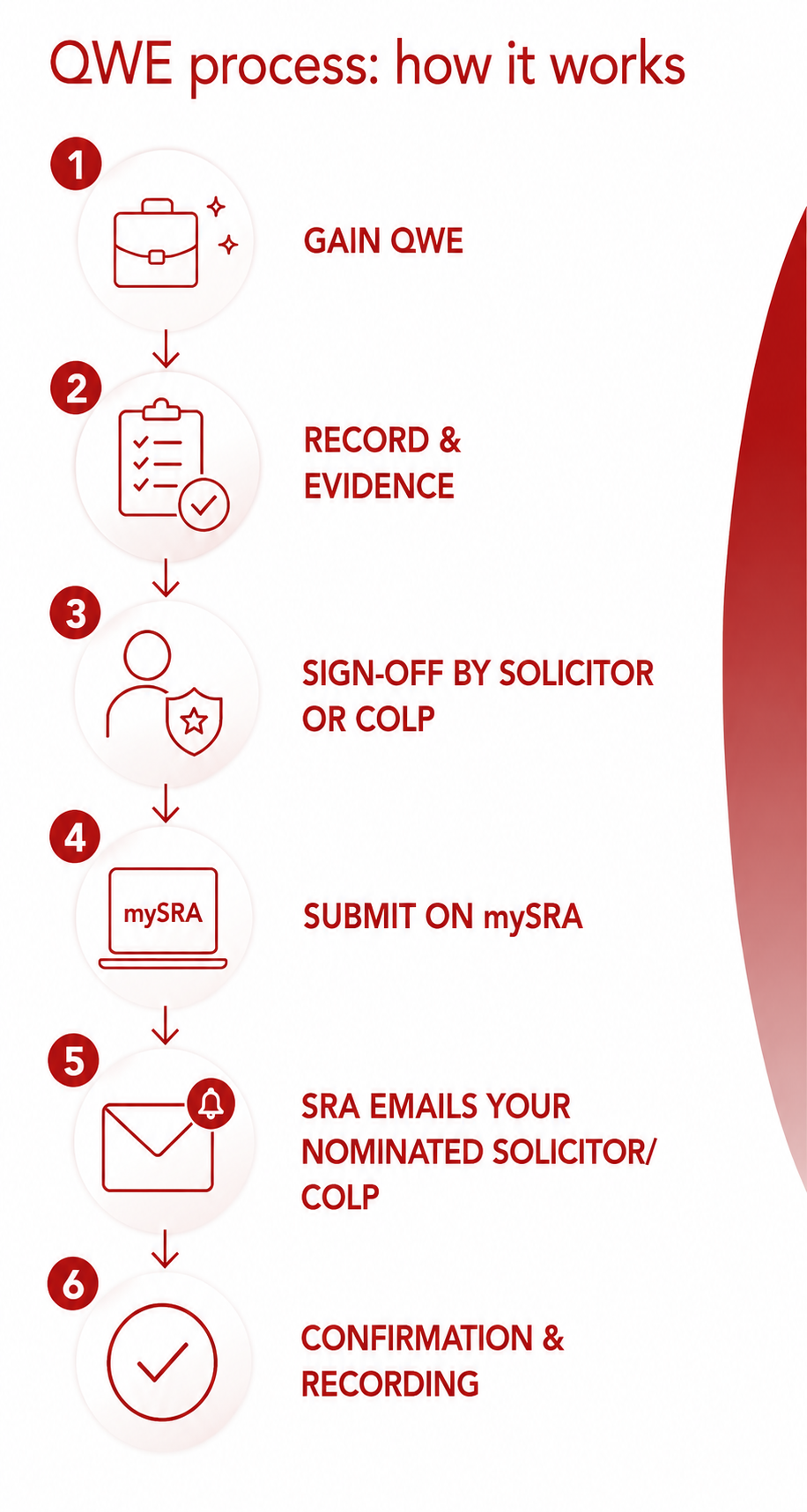
Your QWE must be signed off by a solicitor regulated by the SRA, or by a Compliance Officer for Legal Practice (COLP). In most cases, the solicitor signing off will work in the same organisation as you.
For most candidates, your supervisor or someone else at the organisation you worked at will sign a declaration confirming that you spent time working with them and developed your legal skills.
The person signing does not have to be a solicitor at your firm, as long as they have direct knowledge of your work (for example, by reviewing a training diary), they can sign your QWE off.
The solicitor who signs off your QWE must confirm:
Firms or other organisations do not need to register with the SRA, or be regulated by the SRA, to offer QWE.

Once your QWE is signed off, it is recorded on the SRA’s mySRA portal — the same system you’ll use later to apply for admission as a solicitor.
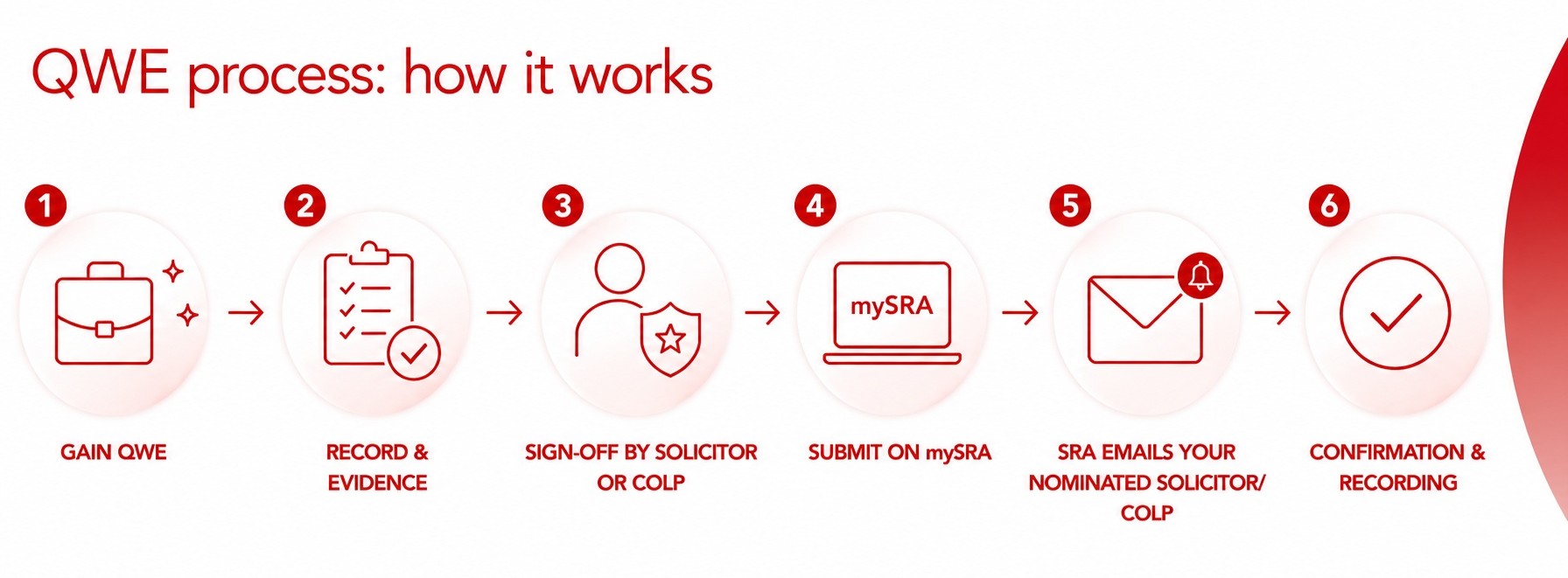
Not every candidate has a solicitor at their workplace who can confirm their QWE. This is common for candidates working abroad with no English-qualified solicitors, paralegals at non-regulated firms, or volunteers at certain charities.
In these cases, you can work with an external solicitor regulated by the SRA to confirm your QWE. The external solicitor reviews your work, usually through a training diary, a portfolio of work, or feedback from your supervisor, and signs it off.
Learn more about how you can get the assistance of an external confirming solicitor.
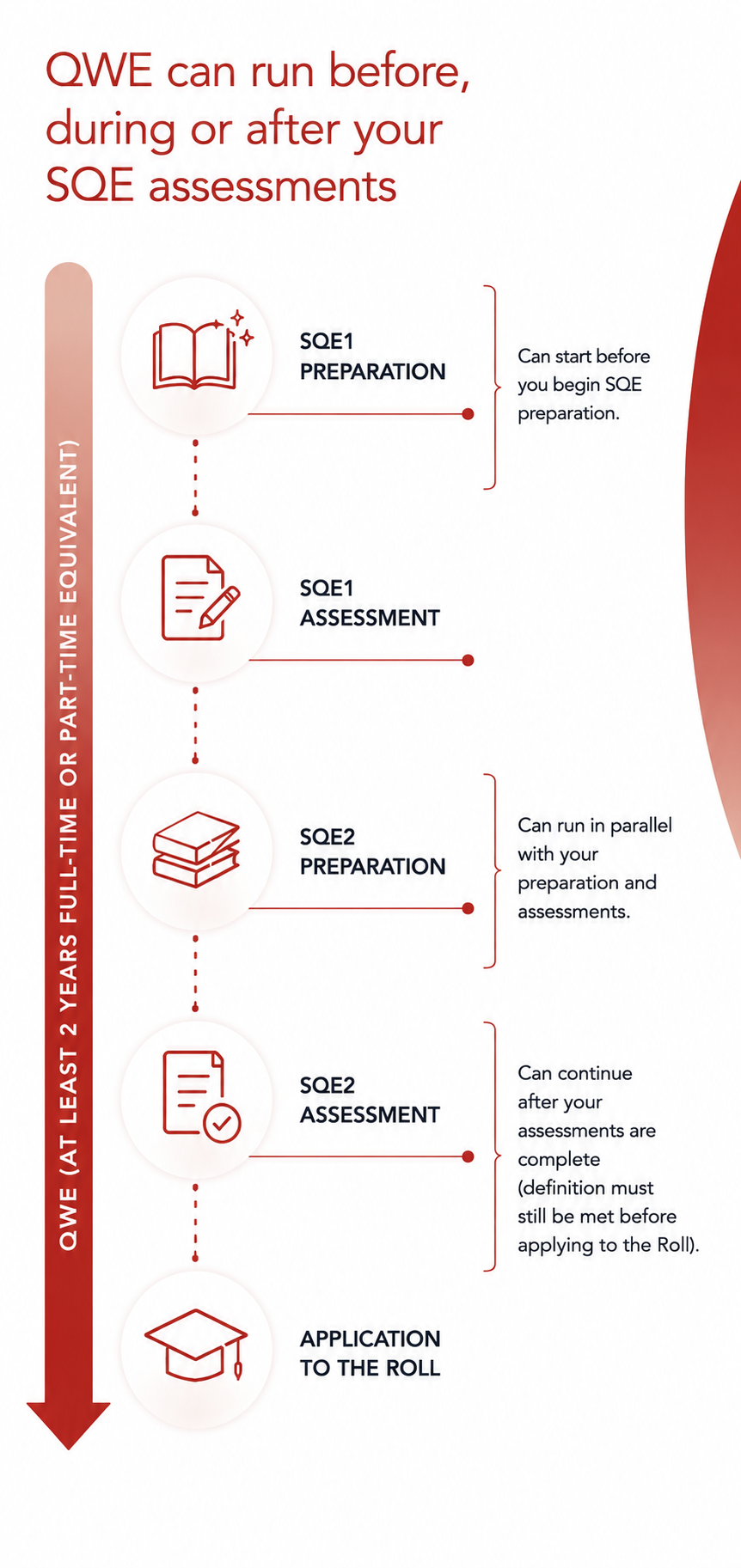
You can complete your QWE before, during, or after your SQE assessments. The two-year requirement must be met before you apply for admission to the Roll of Solicitors.
Any experience gained before signing up for the SQE can be banked and counted towards QWE. There are no time limits on when you can claim experience as QWE or how far back it can go, provided it meets the SRA’s requirements. You do not need to register with the SRA before you start your QWE.


Yes. There is no time limit on how far back QWE can go, provided the work meets the SRA’s requirements and gave you the chance to develop the competences in the SRA’s Statement of Solicitor Competence.
Yes. QWE can run in parallel with your SQE preparation. Many candidates do this, preparing for SQE1 or SQE2 while working in a paralegal role that counts towards their two years.
Most candidates keep a training diary that logs the work they have done, the competences developed, and feedback from supervisors. This is the document the signing solicitor will rely on. You should also keep your supervisor’s contact details and any formal performance reviews.
Yes. QWE can be paid or unpaid. Volunteering at a law centre or charity (such as Citizens Advice) counts, as does pro bono work, provided it gave you the chance to develop the competences.
Yes. Part-time QWE counts on a pro-rata basis. You need to complete the equivalent of two years of full-time work in total, but you can do it over a longer period.
You can split your QWE across up to four different employers. Each block of work needs to be signed off by a regulated solicitor or COLP, usually at the organisation where the work was done.
The SRA may audit QWE submissions, so it’s important that the work, the competences developed, and the signing solicitor’s confirmation are accurate. Keep your training diary and supporting evidence in case the SRA asks for it.
Full QWE guidance is on the SRA website.
Whether you have already started QWE or are planning ahead, here’s what to do now:
Plan your SQE preparation in parallel — see our SQE courses to find the path that fits your timeline and background.
Watch our short video for additional QWE advice and tips.