The final step in qualifying as a solicitor in England and Wales — what the SRA needs, how to apply, and what to expect after admission.
Once you have completed the academic stages of qualification — your degree (or equivalent), both stages of the SQE, and your qualifying work experience (QWE) — there is one final step before you can call yourself a solicitor: admission to the Roll of Solicitors of England and Wales.
Admission is granted by the Solicitors Regulation Authority (SRA). It involves a formal application, character and suitability checks, the payment of admission fees and, once approved, formal entry onto the Roll.
The Roll of Solicitors is the official register of solicitors qualified to practise in England and Wales. It is maintained by the SRA. Being on the Roll is what allows you to use the title “solicitor” and, with a practising certificate, to practise law in this jurisdiction.
You can only practise as a solicitor in England and Wales once you have been admitted to the Roll. Until that point, you may have passed your assessments and completed your work experience, but you are not yet a solicitor in the legal sense.
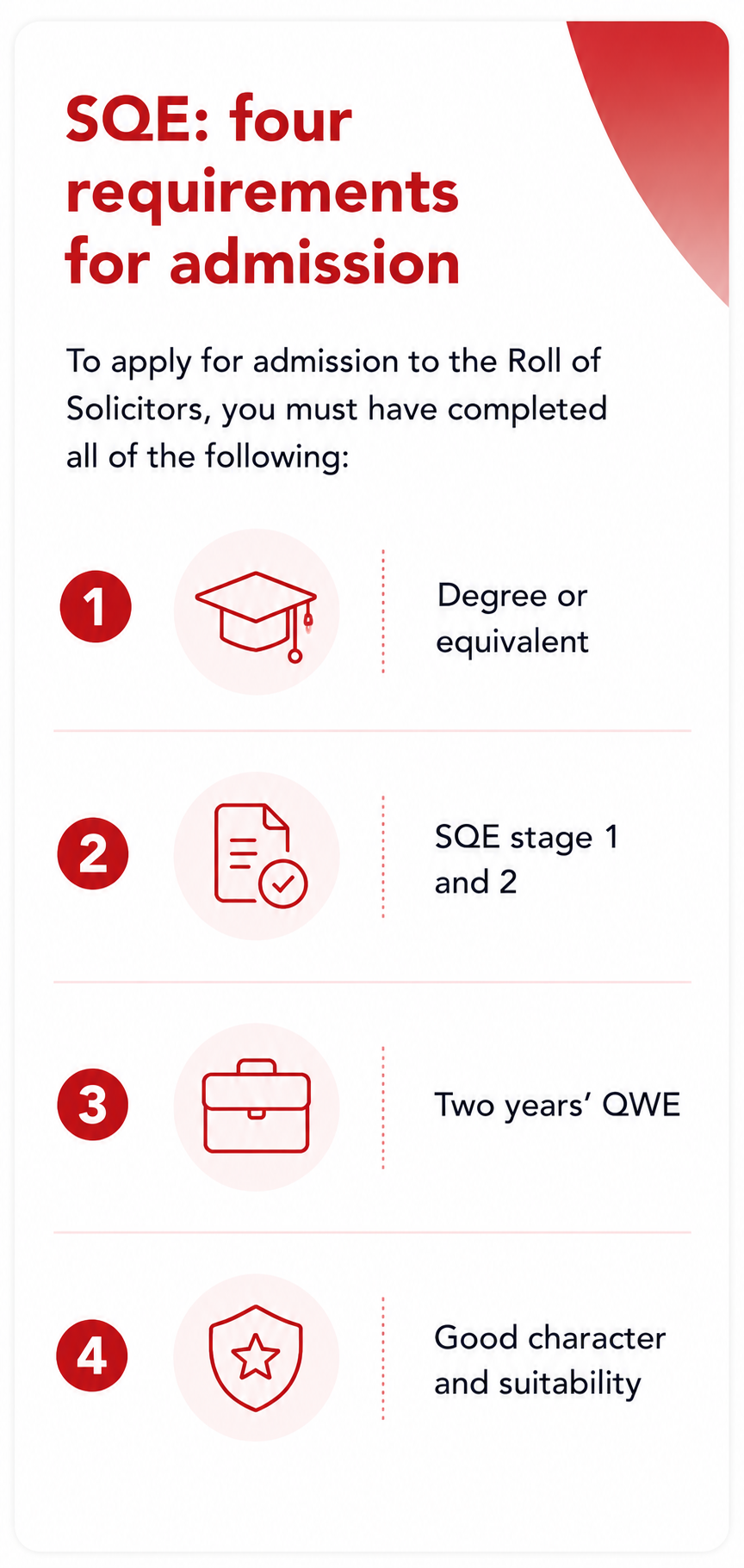
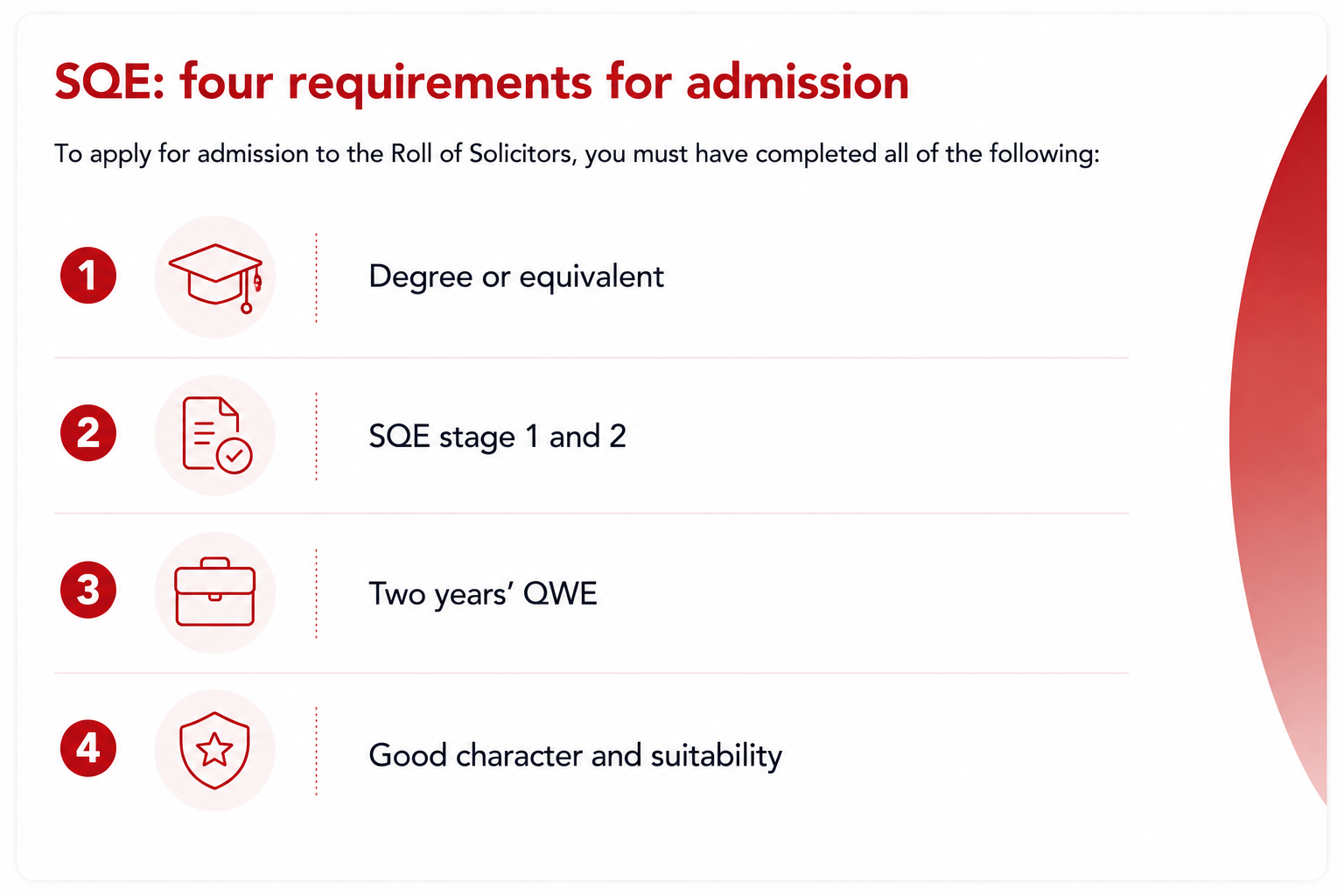
To apply for admission to the Roll of Solicitors, you must have completed all of the following:
If English or Welsh is not your first language, you will also need to demonstrate that you can communicate in either language to the level required to practise. The SRA accepts a range of evidence for this, including recognised English language qualifications and confirmation that you have studied or worked in English at the required level. Check the SRA’s current guidance for the latest list of accepted evidence.
Still working through the SQE? Most candidates apply for admission within a few months of passing SQE2 and completing their QWE.
The SRA assesses every applicant against its Assessment of Character and Suitability Rules. This is to protect the public and maintain confidence in the profession.
The SRA will ask about matters including:
Having something to disclose does not automatically disqualify you. The SRA considers each application on its facts, including the seriousness of the issue, how recently it occurred, the circumstances, and what has happened since. Failing to disclose something, however, is treated very seriously and is usually more damaging than the underlying issue itself.
If you have a matter you are unsure about, it is sensible to seek advice from the SRA or a regulatory specialist before submitting your application.

The application is made online through your mySRA account, the SRA’s secure portal.
Make sure all of the following are recorded on your mySRA account before you apply:
Any exemptions you have been granted will appear on your mySRA account.
From your mySRA account, complete the admission application form. You will be asked to:
Check the SRA website for the current admission application fee, as fees are reviewed periodically.
The SRA reviews your application and supporting evidence. Most straightforward applications are processed within a few weeks. Applications that involve character and suitability disclosures, or that require additional evidence, can take longer.
You can track the status of your application through your mySRA account. The SRA may contact you for further information during the review.
Once your application is approved, the SRA will admit you to the Roll of Solicitors. You will receive confirmation through your mySRA account and your name will appear on the SRA’s public register of solicitors.
From the date of admission, you are formally a solicitor of England and Wales.
Admission to the Roll makes you a solicitor, but it does not automatically allow you to practise. To work in a role that requires a practising certificate, for example, advising clients in a law firm regulated by the SRA, you also need:
A practising certificate is the SRA’s annual authorisation that lets you act as a solicitor. Most newly admitted solicitors apply through their employer, who handles the renewal centrally each year. The certificate is renewed annually and currently runs to a fixed renewal date set by the SRA — check mySRA for the current cycle and fee.
You can be on the Roll without holding a practising certificate. Many in-house lawyers, academics, foreign qualified lawyers and others use the title “solicitor” without one. You will need a practising certificate the moment your role involves reserved legal activities or work that the SRA considers requires one.
All solicitors in England and Wales are responsible for keeping their knowledge and skills up to date throughout their career. The SRA does not require a fixed number of CPD hours. Instead, solicitors must regularly reflect on the quality of their practice, identify any learning and development needs, address those needs, and record what they have done.
Each year, you confirm to the SRA that you have done this — usually through your annual practising certificate renewal.
If you practise in a law firm regulated by the SRA, your firm must hold a minimum level of professional indemnity insurance that complies with the SRA’s Minimum Terms and Conditions. As an individual solicitor, you do not arrange this yourself — your firm does.
If you go on to set up your own firm, you become responsible for arranging compliant cover.
From the date of admission, you are bound by the SRA Principles and the SRA Code of Conduct for Solicitors, RELs and RFLs. These cover, among other things, honesty, integrity, independence, acting in the best interests of clients, maintaining client confidentiality and behaving in a way that maintains public trust in the profession.
Familiarising yourself with these rules before you start practising is one of the best investments of time you can make at the start of your career.
There is a six-year limit on completing the SQE itself. Once you sit your first SQE assessment, you must pass both SQE1 and SQE2 within six years, and you can take each stage a maximum of three times within that window. Admission to the Roll does not have a separate deadline, but it cannot happen until both stages are passed, so the six-year SQE window is the constraint to plan around.
Most candidates apply for admission as soon as they have completed both the SQE and their QWE. If you have a job offer that is conditional on admission, your employer will usually expect you to apply promptly. Allow several weeks for the SRA review, and longer if there are character and suitability matters to consider.
If you are still completing your QWE, you can submit the QWE confirmation through your mySRA account ahead of time. Many solicitors choose to apply for admission immediately after the final block of QWE is confirmed.
If you are already qualified as a lawyer outside England and Wales, you are automatically exempt from the QWE requirement. In most cases you can also apply to the SRA for exemption from SQE2, leaving SQE1 as the only assessment to complete before applying for admission.
Most straightforward applications are decided within a few weeks of submission. Applications with character and suitability disclosures or that require additional evidence can take longer. You can track the status of your application through your mySRA account.
No. You can describe yourself as a solicitor in England and Wales only once the SRA has formally admitted you to the Roll. Until that point, even if you have passed both SQEs and completed your QWE, you are not yet a solicitor in the regulatory sense.
Not necessarily. You can be on the Roll without holding a practising certificate, and many people do so — for example, in-house lawyers in some roles, academics or those taking a career break. You need a practising certificate from the moment your role involves work that the SRA considers requires one.
Disclose it honestly and in full. The SRA considers each application on its facts and many disclosures are accepted. Failing to disclose is usually treated more seriously than the underlying issue. If you are unsure, take advice from the SRA or a regulatory specialist before submitting.
No. There is no residency requirement to be admitted to the Roll of Solicitors of England and Wales. Many candidates qualify and practise from outside the UK.
There is no compulsory interview or ceremony as part of the SRA admission process. In rare cases involving character and suitability disclosures, the SRA may request additional information or an interview. Otherwise, admission is administrative. Once approved, your status is confirmed through your mySRA account, and your name is added to the Roll. The Law Society and some local law societies organise optional admission events that newly admitted solicitors can choose to attend separately.
The SRA charges an application fee for admission, which is reviewed periodically. Check the SRA website for the current fee before you apply.
Admission is the destination, but it sits at the end of a sequence that takes most candidates two to four years from starting their SQE preparation. Wherever you are on that journey, the following may help:
Focus on passing both stages and completing your QWE. Admission is administrative once those are done.
Keep a clear record of the work you do and the SRA competencies it covers. Confirmation is much easier when your record is contemporaneous and detailed.
You are ready to apply. Log into your mySRA account and follow the admission application steps above.
If you are at the beginning of your journey, the most important step is choosing a preparation route that fits how you study and the time you have available. Our SQE1 and SQE2 course packages include textbooks, videos, flashcards, revision notes, mock tests with AI-powered feedback and structured exam-technique guidance.